Easter in Norway. 30 knots, a frozen lake, fresh powder and a wing in our hands.
This wasn’t planned. It never is when it’s good.
We were on a family trip with a few friends, somewhere in the Norwegian backcountry. The kind of landscape where you stop talking and just look. My first real winter trip outside of Austria, and nature did not disappoint.
Snow Kiting First, Then the Storm Hit
The first session was snow kiting. We found a wide open field, no trees, no mountain, just space, and spent an afternoon going uphill on skis, kite-powered, then riding back down. Straightforward, exhilarating, a great warm-up for what was coming.
Two days later, 30 centimeters of fresh snow fell overnight. The road to our original spot was closed. But then the sky cleared and the wind came. 30 knots easy, gusty, serious.
We needed a different plan.
The Frozen Lake
Right in front of where we were staying: a big frozen lake. We had seen husky tours running there, and an ice fishing competition had just taken place the day before. Locals confirmed the ice was thick enough. People were already walking across.
Good enough for us.
We rigged a 3.5 and a 2.5 for the kids, walked out onto the ice, and let the wing do its thing.
What happened next was one of those sessions that stays with you.
The wind kept building. Snow started flying horizontally across the lake, forming dunes you could actually surf through on skis. Full speed runs. Gusts that pushed you like a truck. All of it set against the Norwegian winter landscape, frozen lake, snow-covered hills, total silence except for the wind.
Mia was there. Nico, Sammy. Even people who had never touched a wing before were having a go, and within minutes, they were cruising.
Why Snow Winging Is the Best Introduction to Wing Control
Here is the thing that struck me watching the beginners: once they figured out how to hold the wing, how to keep it up, how to angle it forward, how to power and depower, the rest came naturally. Skis give you stability. You can go slowly. You can stop without drama.
Compare that to learning in water on a foil. If the wing does not work, you are going nowhere and the current is taking you. If you fall, you are wet. If you go too fast, the foil does unexpected things. There is a lot going on at once.
On snow or ice, the variables collapse. The ski keeps you stable. The wing is your one focus.
And when something goes wrong? You let go. The wing is on your leash, drops into the snow, and everything stops. No drama. No danger.
This is worth thinking about if you are teaching someone to wing, or if you want to consolidate your own fundamentals.
Wing control separates clearly from body movement. On a foil, everything influences everything: your weight, your trim, your wing angle, your speed. On skis, your ski tracks independently. You can hold an imperfect body position and still move forward. That isolation helps you actually feel what the wing is doing.
Going upwind is learnable at any speed. On a foilboard before you are foiling, slogging upwind is genuinely difficult. You need power and angle and a board that wants to go somewhere. On skis you can dial in the angle at walking pace, feel when the wing starts pulling you upwind, and adjust from there. Room to experiment without consequence.
Body tension becomes visible. When you are loose and floppy, the wing does not transmit power efficiently. You feel it immediately, you slow down, you drift. When you engage your core and extend your arms properly, you feel the difference. This carries directly into water.
The power zone makes sense. Angling the wing forward and down to go faster, opening it to depower, keeping it neutral overhead: all of this becomes intuitive when you are on a stable platform. The feedback loop is clear because nothing else is competing for your attention.
The Takeaway
Snow winging is not a gimmick. It is a legitimate training tool and an incredible experience in its own right.
If you have skis and a wing and there is snow, go. Take a beginner. Watch them figure it out in 20 minutes. Then try to go upwind as efficiently as possible and you will realize how much you still have to learn too.
We are coming back next winter. And I am bringing a quiver.
Until then: back to Tarifa, back to 20 degrees, back to the sea.
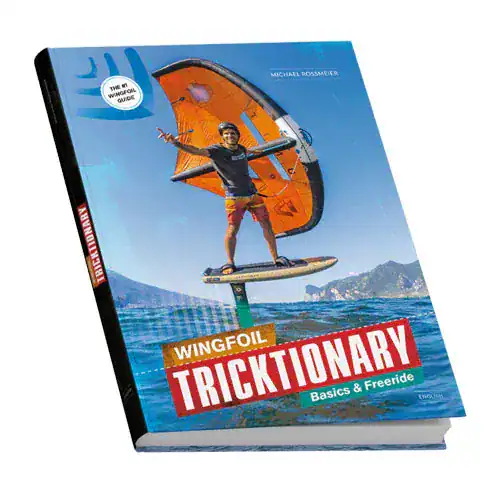
The fundamentals behind what makes snow winging such a good training tool, wing control, body posture, going upwind, separating wing and body movement, are all in Michi Rossmeier’s book:
Wingfoil Tricktionary 1 – Basics&Freeride Edition.